From court judgement to
client-ready strategy
CaseDesk scores the judgements worth acting on and turns your case files into a structured, role-aware brief — applicable law, precedent, timeline, and drafts — grounded in your own documents.
Closed beta · Onboarding founding firms · No credit card required
Sourced from the Supreme Court, High Courts, and India Code
- 846
- Central Acts, fully indexed
- 40,496
- Statute sections, searchable
- 9
- AI agents per case analysis
- 6
- Signals behind every lead score
Find the work. Win the work.
CaseDesk brings court intelligence and case preparation together — spot the matters worth pursuing, then build the strategy to take them on.
A registry that reads the judgement for you
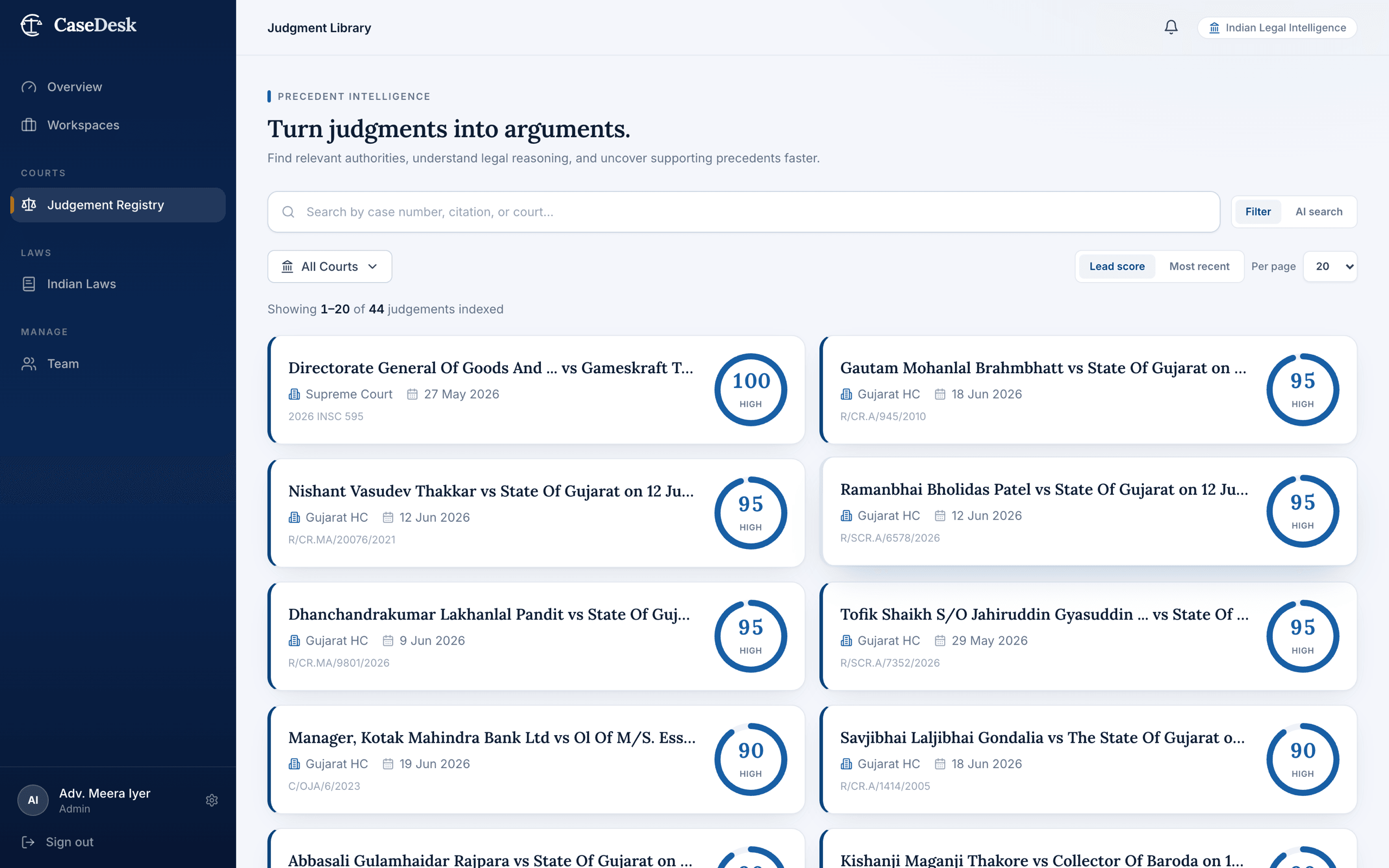
Every Supreme Court and High Court judgement in the registry is scored, summarised, and broken down — so a partner can see, at a glance, which decisions open a business-development opening and why.
- HOT lead score with a transparent six-signal breakdown
- AI-extracted parties, issues, holding, and outcome
- SLP / appeal window countdown on every eligible matter
- Filter by court and date, sort by lead score, or search in plain language
Turn a folder of documents into a case strategy
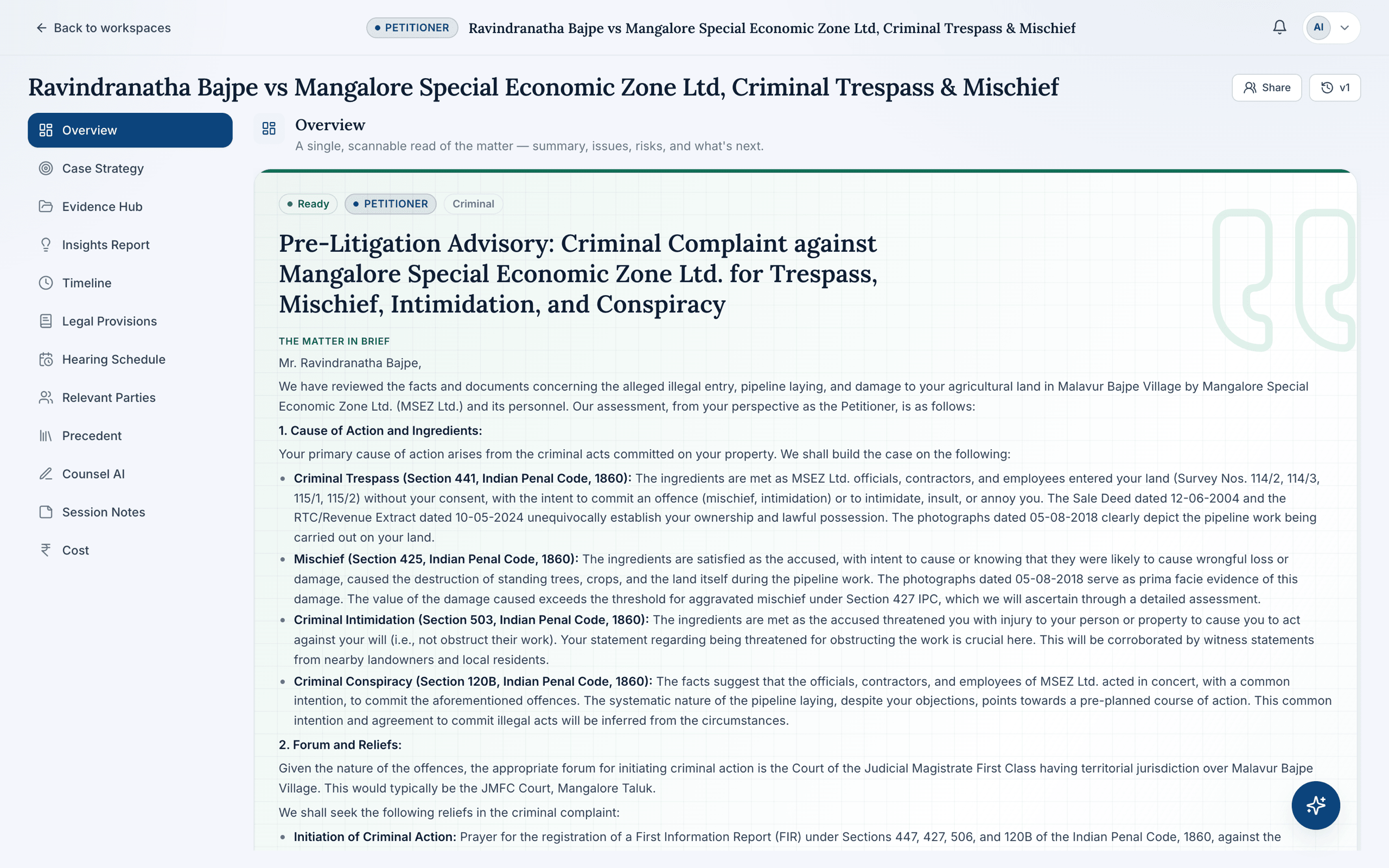
Open a workspace, pick your side, and upload what you have. A nine-agent pipeline reads every document and returns a structured, role-aware brief — the same analysis a junior would spend days assembling.
- Role-aware framing for petitioner, respondent, mediator, or adjudicator
- Grounded in your own case file — never generic boilerplate
- Strategy, risks, applicable law, timeline, and precedent in one panel
- Ask follow-ups and draft notices in correct Indian legal format
A score you can defend, not a black box
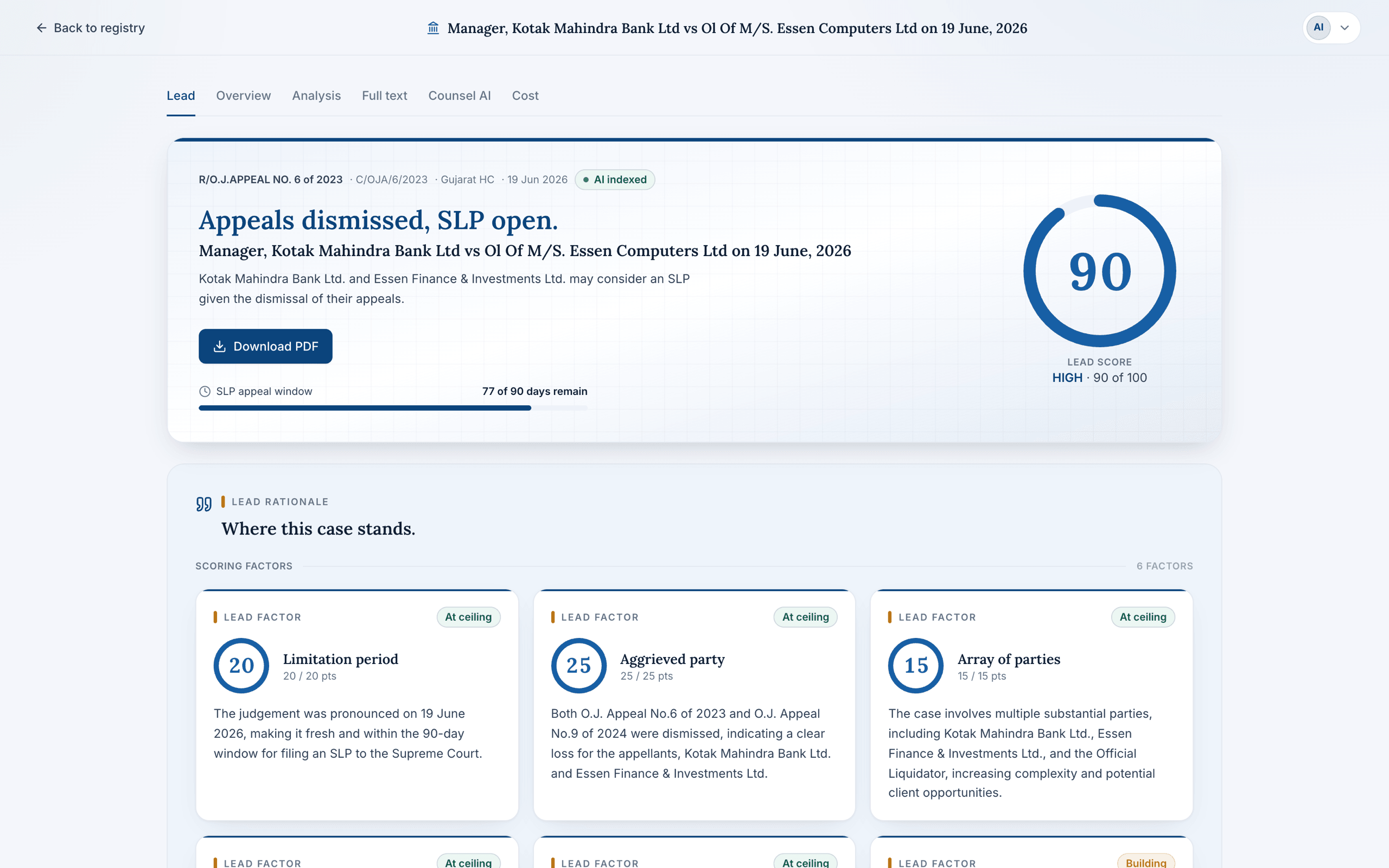
Every judgement carries a HOT lead score from 0 to 100, built from six signals that are shown in full on the matter. You see the number and the reasoning — the limitation window, the aggrieved party, the stakes — so a partner can trust the ranking before picking up the phone.
Limitation period
How fresh the judgement is and whether an appeal window is still open.
Aggrieved party
Whether there is a clearly aggrieved side with reason to act.
Array of parties
The number and substance of the parties involved.
Outcome clarity
How decisively the matter was won, lost, or left open.
Forum & stakes
The court, the value at issue, and what is on the line.
Appeal viability
Whether an SLP or further appeal is realistically on the table.
One matter, read eight ways
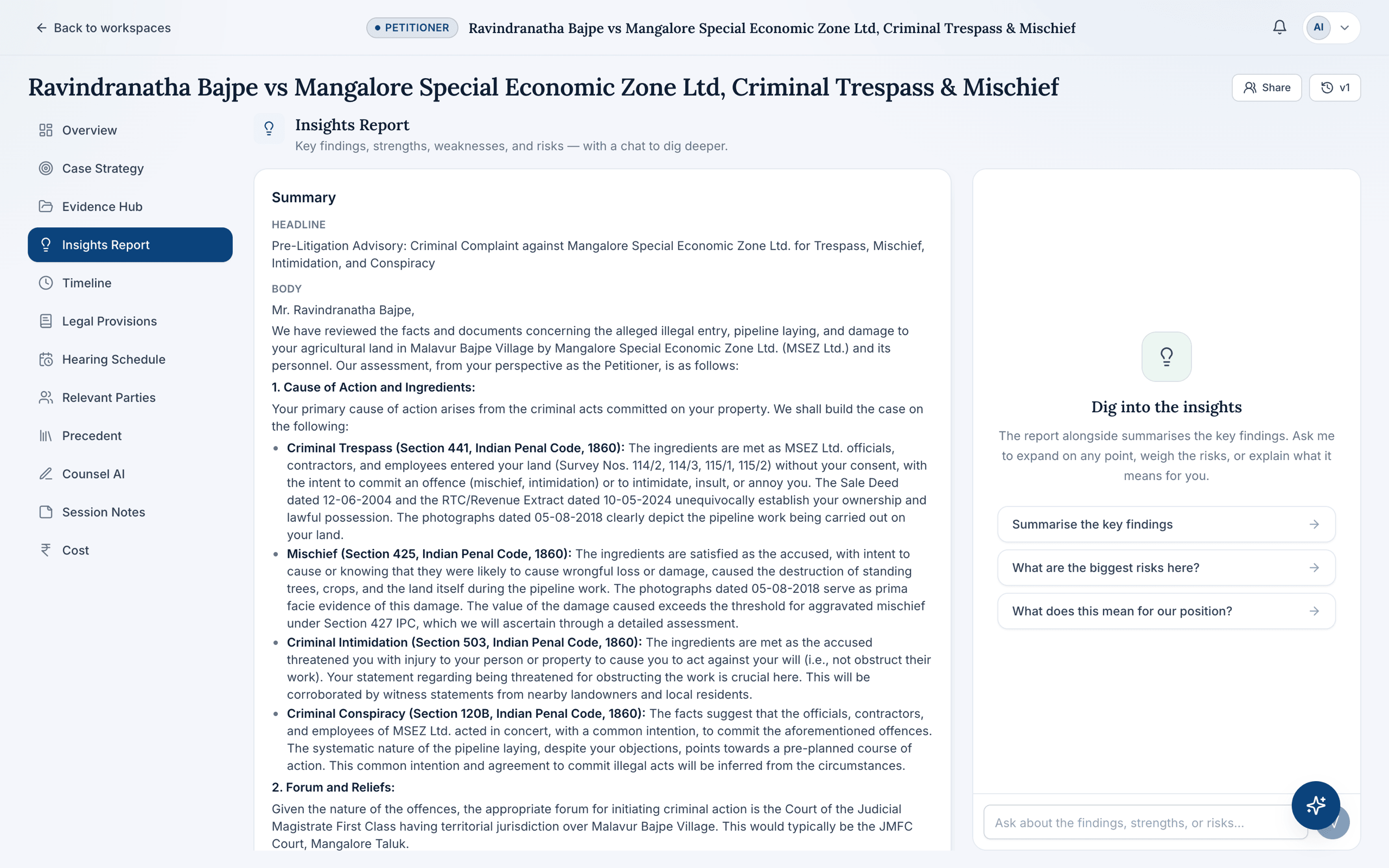
The intelligence panel breaks every case into the sections a lawyer actually works from — each one generated from your documents, each one open to follow-up questions.
Overview
A single, scannable read of the matter — summary, issues, risks, and what's next.
Case Strategy
Work through case strategy, posture, and how to counter the other side.
Insights Report
Key findings, strengths, weaknesses, and risks — with a chat to dig deeper.
Timeline
The chronology of events, limitation periods, and deadlines.
Legal Provisions
The statutes and sections that apply — with a chat to test how they bite.
Precedent
Analogous judgements and how their ratio applies to your matter.
Relevant Parties
The parties, their roles, interests, counsel, and relationships.
Counsel AI
Ask senior counsel anything — advice, next steps, or drafting a document.
Intelligence with its feet on the record
CaseDesk is built for the way Indian litigation actually works — grounded in your file, framed for your side, and fluent in the statute and precedent that decide the matter.
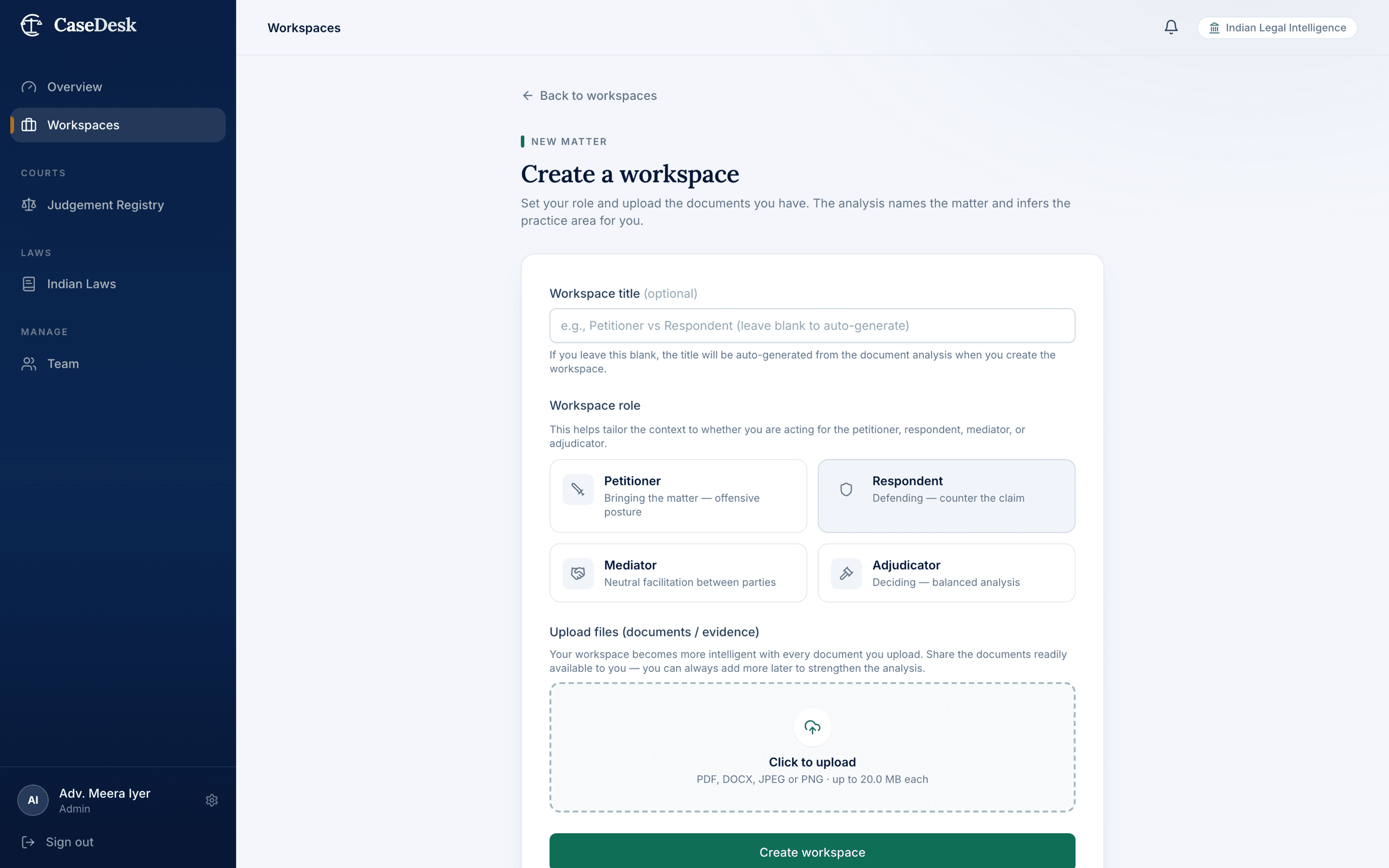
The same facts, argued for your side
Set the workspace role when you create a matter and every section — strategy, risk, posture — is written for that position. A respondent's brief reads differently from a petitioner's, exactly as it should.
- Petitioner
- Bringing the matter — an offensive posture.
- Respondent
- Defending — countering the claim.
- Mediator
- Neutral facilitation between parties.
- Adjudicator
- Deciding — a balanced analysis.
Grounded in your file
Every answer is drawn from the documents you upload — no hallucinated facts, no generic templates. If it isn't in the record, it isn't in the brief.
Role-aware analysis
The same matter reads differently for a petitioner than a respondent. CaseDesk frames strategy, risk, and posture for the side you're on.
Indian-law native
Trained on the shape of Indian practice — IPC and CrPC sections, limitation, SLP windows, forums, and drafting conventions.
Statute at your fingertips
846 Central Acts and over 40,000 sections, filterable by practice area and searchable in plain language — and you can chat with any law.
Precedent that applies
Surface analogous judgements and see how their ratio bites on your facts — supporting authority and authority against, side by side.
Drafts you can send
Notices, replies, and applications generated in correct format, grounded in the matter, with version history you can review and roll back.
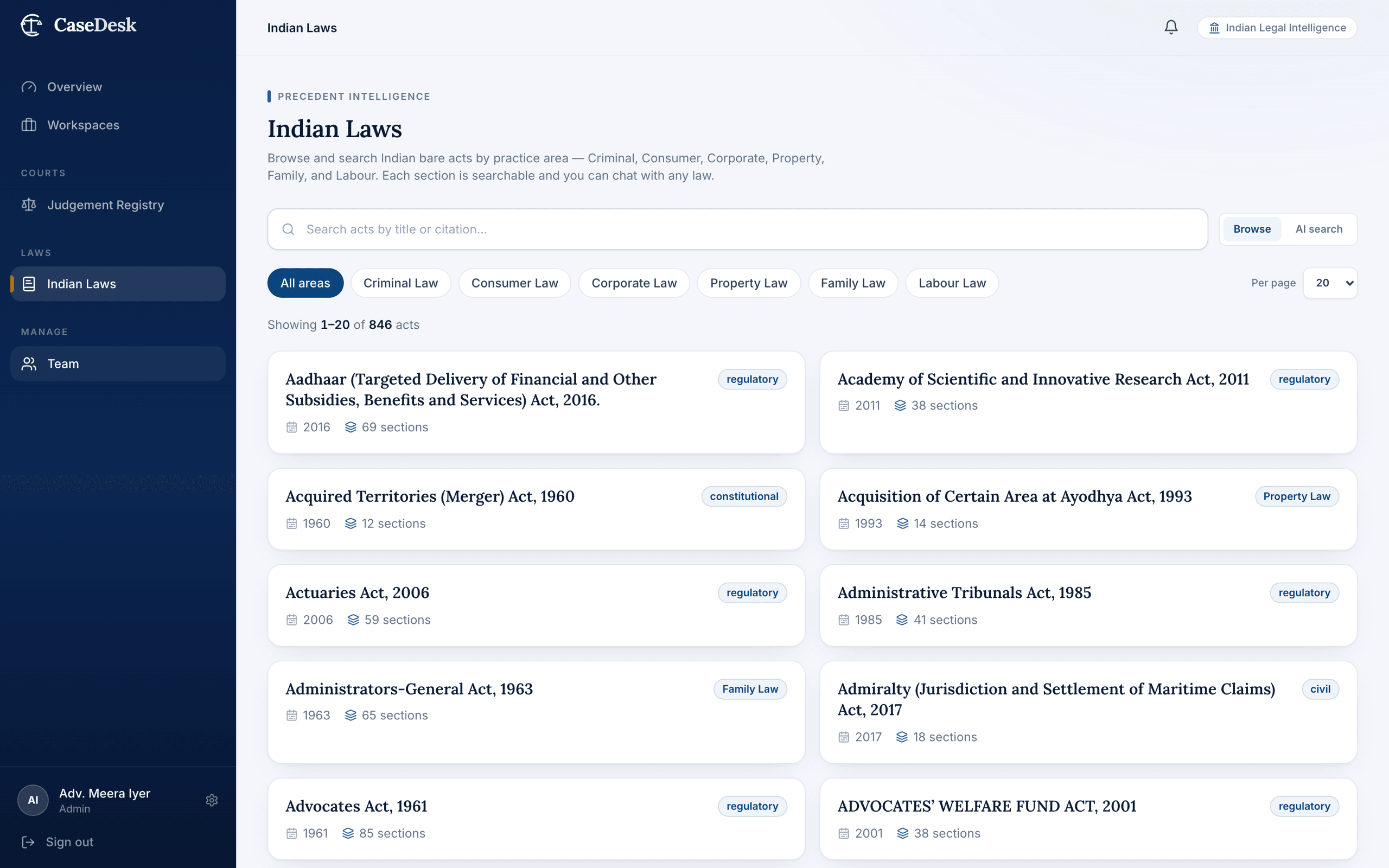
The bare acts, indexed and ready to question
846 Central Acts and more than 40,000 sections, organised by practice area and searchable in plain language. Open any section, or ask a question and let the AI find the provision that governs your point.
Search or browse
Filter by area, or search by title, citation, or plain language.
Chat with any law
Ask how a section applies and get an answer grounded in the text.
Built for the whole matter lifecycle
From finding the client to filing the reply, CaseDesk earns its place at each stage of the work.
Business development
Scan the registry for fresh judgements where a party is likely to need counsel, ranked by a transparent lead score — and reach out first.
Case preparation
Hand a new brief to a workspace and get a structured read of the facts, law, risks, and strategy before the first conference.
Legal research
Find the statutes and sections on point, pull analogous precedent, and pressure-test how each applies — in minutes, not afternoons.
Client-ready drafting
Move from analysis to a first draft of a notice or reply without leaving the matter, in the format your court expects.
CaseDesk does the reading, so the advocate can do the judging. Every brief it writes is grounded in your own file — and every decision that follows stays yours.
The principle behind CaseDesk
Your clients' matters, kept your firm's
Legal work carries privilege. CaseDesk encrypts case documents with AES-256, isolates every firm, and enforces access on the server — so confidential material stays confidential.
AES-256 encryption at rest
Uploaded case documents are encrypted with AES-256-GCM before they ever reach storage, and decrypted only inside the backend. A storage breach yields ciphertext, not client files.
Encrypted in transit
Every request travels over TLS. Sessions use http-only cookies with no tokens exposed to the browser, and passwords are stored with a memory-hard scrypt hash.
Per-firm isolation
Every firm is a separate tenant. Matters, documents, and analysis are scoped to your organisation and never shared across firms.
Role-based access
Firm Admin, Partner, Associate, Paralegal, and Client roles gate what each person can see and do — enforced on the server, not just the UI.
Your data, not training data
Your matter content is used only to produce your own analysis. It is never sold, and never used to train third-party models.
Assistance, not advice
CaseDesk supports qualified lawyers with research and drafting. Every output is for professional review — the advocate stays in control.
Built for Indian law today, architected to travel
CaseDesk is purpose-built for Indian courts, statutes, and firm workflows first — and designed to extend to new jurisdictions as we grow beyond India.
Founding-firm access, open now
CaseDesk is in closed beta with a small group of Indian firms. Pricing is tailored to your firm's size and practice — founding firms get preferential terms and a direct line into the roadmap.
- Full Court Intelligence Registry with HOT lead scoring
- Unlimited case workspaces and document uploads
- The complete nine-agent analysis pipeline
- 846-act statute library with search and chat
- Counsel AI drafting with version history
- Team access with role-based permissions
Questions, answered
What exactly does CaseDesk do?
CaseDesk is a legal-intelligence platform for Indian law firms with two sides. The Court Intelligence Registry scores and summarises Supreme Court and High Court judgements so you can spot business-development openings. The Case Workspace takes your own case documents and, through a nine-agent pipeline, returns a structured, role-aware brief — strategy, applicable law, timeline, precedent, and client-ready drafts.
Where does the analysis come from — is it just a generic chatbot?
No. Workspace analysis is grounded in the documents you upload; the agents read your actual case file rather than answering from general knowledge. The output is framed for the side you're acting on — petitioner, respondent, mediator, or adjudicator — and cites the statutes and precedent that apply to your facts.
How is the HOT lead score calculated?
Each judgement's lead score is built from six transparent signals — including the limitation period, whether there is a clearly aggrieved party, and the array of parties involved. The score and its full breakdown are shown on the judgement, so you always see why a matter is ranked HIGH, not just that it is.
Which documents and formats can I upload?
PDFs, DOCX files, and scanned images (JPEG/PNG) up to 20 MB each. Scanned documents are read with OCR, so photographed or imaged papers work as well as native files. You can add more documents at any time to strengthen the analysis.
Is my clients' data kept private?
Yes. Every firm is an isolated tenant, and matters are scoped to your organisation — never shared across firms. Access within your firm is controlled by role, and authentication uses http-only cookies with no tokens exposed to the browser.
Does CaseDesk give legal advice?
No. CaseDesk provides research and drafting assistance for qualified lawyers. Every output is for professional review by an advocate, who remains responsible for the advice given to the client.